
|
Getting your Trinity Audio player ready... |
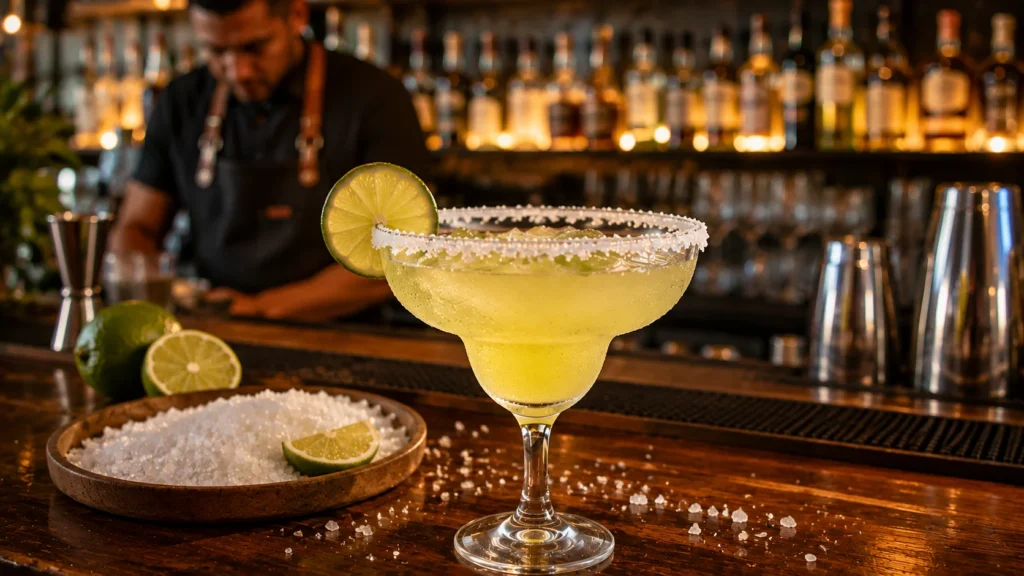
Most margarita recipes just say “salt the rim” and leave it there, as if any salt in the pantry does the same job. It doesn’t. The grain size of the salt you use changes how much of it actually sticks to the glass, and that difference is the real reason some salted rims taste perfect, and others taste like you dunked the glass straight into the shaker. Here’s what each option actually does in practice, and which one fits which style of margarita.
Why Grain Size Matters More Than the Type of Salt
Before comparing specific salts, it helps to understand the one variable that decides almost everything: how much salt physically sticks to a wet rim. Fine grains pack tightly together, so a lime-moistened rim picks up a dense, heavy layer of them.
Coarse grains and flakes are bulkier and irregularly shaped, so fewer of them make contact with the glass, and what does stick sits more loosely and falls away easily when you tap off the excess. That’s the entire reason table salt tastes overpowering and kosher salt doesn’t; it’s not that one is “saltier” than the other by weight, it’s that one physically ends up in a much thicker layer on the glass.
This is also why the salt matters more here than it would if you were seasoning food. You’re not controlling a measured amount the way you would with a recipe; you’re controlling how much surface area of salt makes contact with a wet rim, and grain shape is what decides that.

Table Salt (Iodized): Skip This One
Table salt is the wrong choice for a margarita rim, and it’s worth explaining exactly why instead of just avoiding it on faith. The grains are extremely fine and uniform, so they pack densely onto a wet rim, and you end up with far more salt per sip than any recipe intends.
Iodized table salt also carries a faint metallic, slightly bitter edge from the added iodine and anti-caking agents, which becomes noticeable once it’s concentrated on a rim rather than dissolved into food. If it’s the only salt in your kitchen, a very light single dip with most of it tapped off will work in a pinch, but it’s the one option here that actively fights the drink instead of complementing it.
Kosher Salt: The Reliable Default
Kosher salt is the standard for a reason that has nothing to do with tradition and everything to do with grain shape. It’s flaky and irregular rather than uniform, so it sits loosely on a wet rim and a good portion falls away when you tap the glass, leaving a controlled, even layer instead of a dense crust.
It also has no iodine or anti-caking additives to introduce off-flavors. This is the salt to default to for a classic margarita where you want the rim to support the drink rather than compete with it; it’s what I use in my classic margarita recipe, and it’s the right call for the same reason there.
Sea Salt (Flaky, Maldon-Style): Best Texture, Not Worth It Daily
Flaky sea salt, the pyramid-shaped crystal type rather than fine sea salt, gives the most delicate result of any option here. The crystals are large and hollow, so almost nothing sticks per unit of rim contact, which means an even lighter, more refined salinity than kosher delivers. It also looks noticeably nicer on the glass, with visible, irregular flakes instead of a uniform dusting.
The catch is cost: a box of a premium flaky sea salt runs several times the price per ounce of a box of kosher salt, and for a rim you’re mostly tapping off and discarding, that premium buys you a marginal upgrade rather than a transformative one. It’s worth it if you’re hosting a smaller, higher-end tasting where every detail is being noticed. For a regular Tuesday-night margarita, kosher gets you 90% of the way there for a fraction of the cost.
Fine sea salt, by contrast, behaves much closer to table salt because the grain size is small, don’t assume “sea salt” automatically means the flaky version. Check the label for “flaky” or “coarse” specifically.

Himalayan Pink Salt: A Gentler Alternative With a Reason to Choose It
Himalayan pink salt has a similar coarse grain structure to kosher, so it behaves comparably in terms of how much sticks to the rim. What it adds is a very mild mineral note, slightly less sharply salty than kosher gram for gram, which makes it a good fit for sweeter, fruit-forward margaritas where you don’t want the rim fighting a delicate flavor.
If you’re making something like a strawberry margarita, where the fruit’s sweetness is doing a lot of the work, the slightly softer edge of pink salt lets the fruit stay forward instead of getting cut off by a sharper mineral salt.
Tajín: Not a Salt Substitute, a Different Category
Tajín is a chili-lime-salt blend, not a pure salt, and it’s worth treating as its own category rather than comparing it head-to-head with kosher or sea salt on saltiness alone. The chili and dehydrated lime add tartness and mild heat on top of the salinity, which means it’s doing more flavor work per rim than a plain salt would.
That makes it a strong match for two specific situations: fruit margaritas, where the citrus note in Tajín reinforces what’s already in the glass, and spicy margaritas, where the chili complements rather than competes. It’s the rim I reach for on a jalapeño margarita more often than plain salt, since the heat on the rim and the heat in the drink read as intentional rather than random. On a straightforward classic margarita, though, it can pull focus from the tequila and lime rather than supporting them; save it for drinks where its extra flavor has something to play off of.
Does the Salt Actually Change the Taste of the Drink Itself?
It’s worth being direct about this, since it’s the most common misconception: salt on the rim doesn’t make the whole drink salty if it’s applied correctly. It affects only the sips that touch the rimmed edge, and its main job is suppressing bitterness on your palate so the citrus tastes brighter and the tequila tastes smoother, rather than adding salinity to the liquid itself. That’s a taste-perception effect, not a recipe change; I go deeper into the actual mechanism behind why this works in my guide to margarita garnishes, including the most common mistake people make when applying it (salting the inside of the rim, which does make the drink taste salty, since it falls directly into the liquid).
Do You Need to Buy Salt Marketed Specifically for Margaritas?
No. Specialty “margarita salt” sold in cocktail sections is almost always just coarse kosher or sea salt repackaged at a markup, sometimes with citrus zest or coloring added. You can replicate the citrus version yourself by crumbling a little fresh lime or orange zest into kosher salt on a cutting board, which costs nothing extra beyond salt you probably already own and gives you control over how much zest goes in.
Should You Ever Use Sugar Instead of Salt?
For a standard margarita, salt does something sugar can’t: it suppresses bitterness and sharpens the citrus, while sugar would just add more sweetness to a drink that’s already balancing sweet, sour, and strong. Sugar rims make more sense on genuinely dessert-style variations, where you’re deliberately leaning into a sweeter profile rather than balancing a classic sour structure. If you’re rimming a standard margarita, salt is doing a job sugar isn’t built for.
The Short Version
For an everyday classic margarita, kosher salt is the right default; it’s inexpensive, additive-free, and its grain shape keeps the rim from turning overpowering. Reach for flaky sea salt when you want a marginally more refined result for a special occasion, Himalayan pink for fruitier margaritas that need a gentler edge, and Tajín specifically for spicy or fruit-forward margaritas where its extra flavor has something to complement. The one to actually avoid is fine iodized table salt, not because of tradition, but because its grain size guarantees you’ll end up with more salt on the rim than the drink can handle.
References
- The Cookful: Taste Test: Best Salt for Rimming Margarita Glasses: comparative taste test of table, kosher, and Maldon sea salt
- Mixly Beverage Co: The Best Salt for Margarita Rims: flavored and DIY citrus salt variations

Muhammad Hussain is the creator of MargaritaLab.com, where he tests and analyzes margarita recipes, ingredients, and techniques to help readers make better drinks at home. Over time, he has experimented with different tequila types, lime juice variations, and store-bought mixes to understand what actually makes a balanced margarita.
His approach combines hands-on testing with detailed research, focusing on real-world results rather than theory. Whether comparing fresh vs bottled lime juice or reviewing popular margarita mixes, his goal is to simplify the process and share what truly works.