|
Getting your Trinity Audio player ready... |
If you’ve ever ordered a frozen margarita and received a watery, overly sweet slush instead of a vibrant cocktail, you’re not alone. A proper frozen margarita recipe should taste bright, balanced, and refreshing, not like melted lime candy.
Over the years, I’ve tested ratios, blender speeds, ice types, and fruit variations to perfect a frozen margarita cocktail recipe that delivers real flavor and proper texture every single time. This guide walks you through the authentic structure behind a great margarita drink recipe, frozen, built on classic sour cocktail principles and professional bartending standards.
Let’s break it down properly.
Flavor Balance in this Recipe
Every great margarita, frozen or shaken, follows the classic sour ratio:
2 parts spirit: 1 part citrus: 1 part sweetener
This structure appears consistently in traditional bartending literature and hospitality training programs because it works. It balances four key elements:
- Strong: Tequila provides backbone and character.
- Sour: Fresh lime juice adds brightness.
- Sweet: Orange liqueur or sweetener rounds out acidity.
- Dilution: Ice softens alcohol intensity and integrates flavors.
When you freeze a margarita, dilution behaves differently. Instead of controlled shaking dilution, the blender adds mechanical dilution through crushed ice. Too much ice makes it watery. Too little makes it boozy and harsh.
The key is controlled blending and correct ratios.
The ingredients
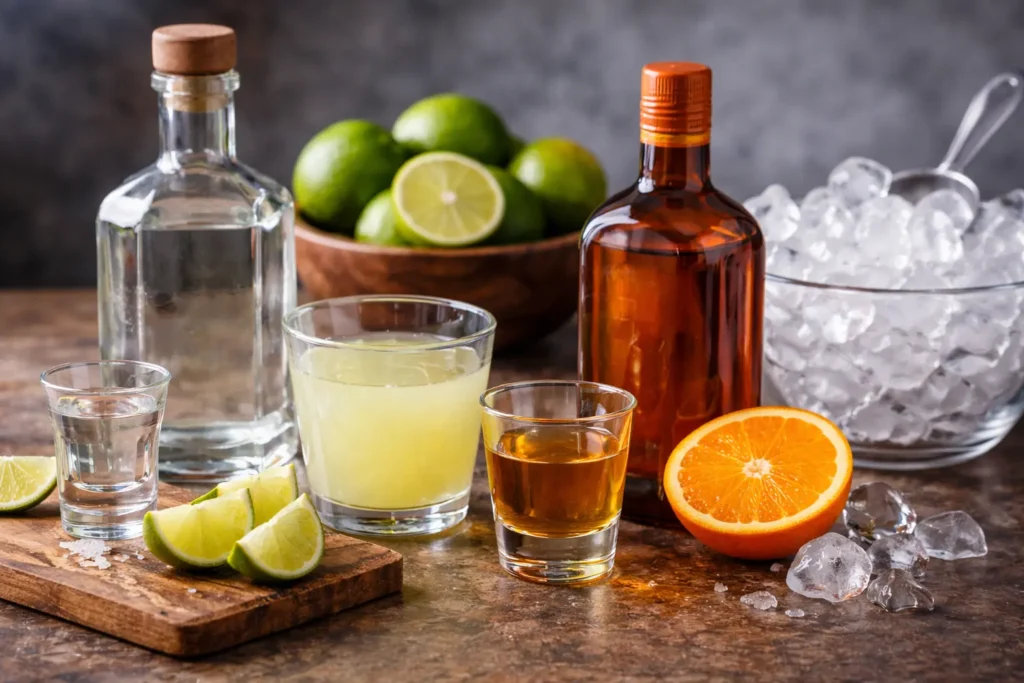
A frozen margarita recipe is only as good as its ingredients. Here’s what actually matters.
Tequila: Blanco vs Reposado
For a classic frozen margarita cocktail recipe, I recommend:
- Blanco (Silver) Tequila: Clean, crisp, agave-forward. Best for bright fruit flavors.
- Reposado Tequila: Light oak aging adds subtle vanilla and spice depth.
Blanco keeps the drink fresh and vibrant. Reposado adds warmth. I avoid heavily aged tequila for frozen drinks; oak complexity often gets lost in ice.
Orange Liqueur Options
Orange liqueur provides sweetness and citrus complexity.
- Triple sec (clean and sharp)
- Curaçao (slightly richer)
- Premium orange liqueur for smoother integration
Choose a balanced one; overly sugary triple sec can throw off the ratio.
Fresh Lime Juice vs Bottled
Always use fresh lime juice.
Bottled lime juice contains preservatives that flatten brightness and create bitterness. A frozen margarita depends on fresh acidity to cut through the ice.
Fresh juice transforms the drink from average to professional.
The Perfect Frozen Margarita Recipe
Here’s my go-to frozen margarita recipe that stays smooth and never watery.
Ingredients
- 2 oz blanco tequila
- 1 oz fresh lime juice
- 1 oz orange liqueur
- 1 cup quality ice
- Optional: ½ oz simple syrup (only if needed)
Step-by-Step Procedure
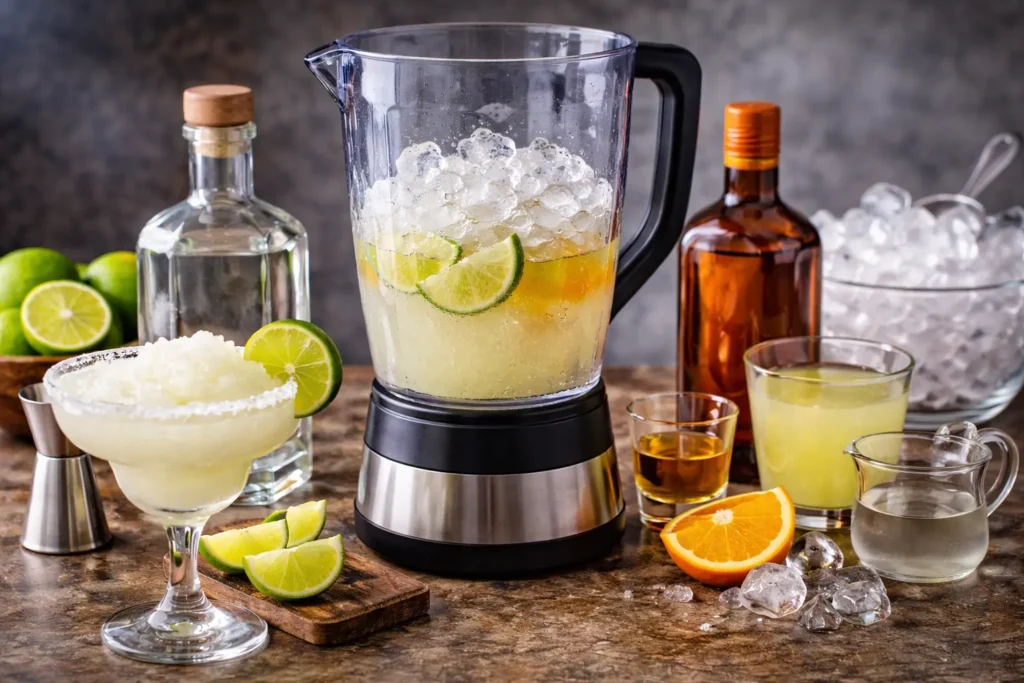
- Add tequila, lime juice, and orange liqueur to a blender.
- Add measured ice (don’t eyeball it).
- Blend on high for 15–20 seconds.
- Stop as soon as the texture turns smooth and slushy.
- Pour immediately into a chilled glass.
That’s it.
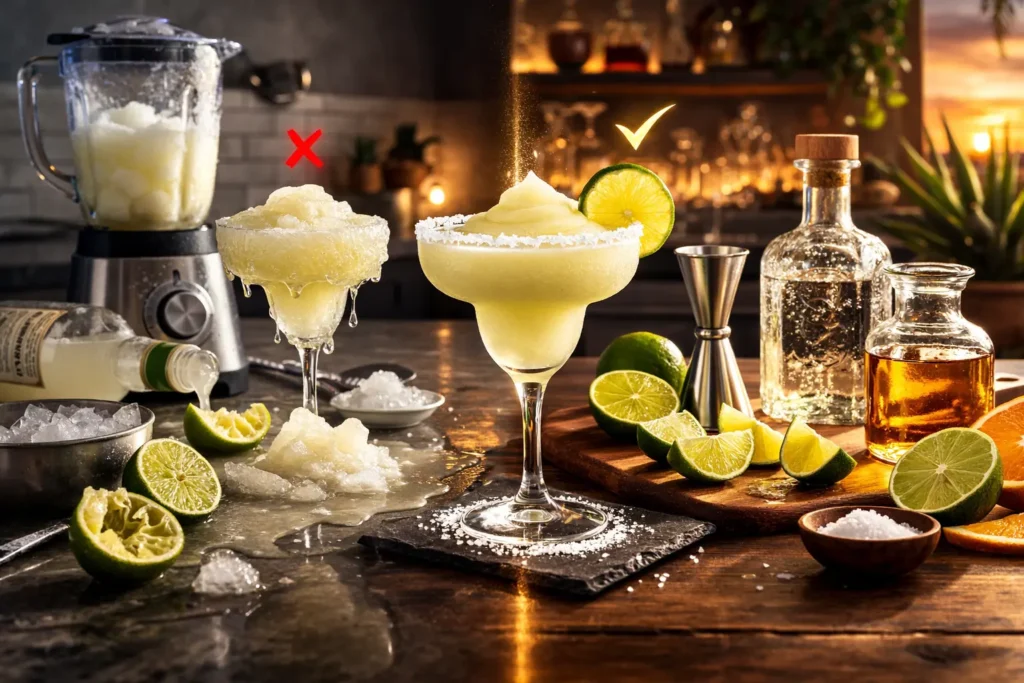
The key is not over-blending. Over-blending creates a rapid melt and watery texture.
Things you have to avoid
Even experienced home bartenders make these errors:
- Adding too much ice “for thickness.”
- Using low-quality tequila
- Skipping fresh lime juice
- Blending too long
- Adding sugar before tasting
Frozen drinks amplify imbalance quickly. Measure carefully.
The Texture: Frozen vs On-the-Rocks
A frozen margarita differs significantly from a shaken version.
Frozen
- Thick, slushy texture
- Lower perceived acidity
- Requires precise ice control
- Slightly softer alcohol perception
On-the-Rocks
- Clearer flavor definition
- Controlled dilution from shaking
- Brighter citrus expression
If your frozen margarita tastes dull, you likely over-diluted it.
To control dilution:
- Use cold ingredients.
- Chill your glass.
- Blend briefly.
- Serve immediately.
Table of Flavor Variations
| Variation | What to Add / Adjust | Balance Tip | Flavor Result |
| Frozen Mango Margarita Recipe | • ½ cup ripe mango chunks • Reduce orange liqueur slightly | Mango adds natural sweetness, so taste before adding an extra sweetener | Thicker texture, tropical sweetness, fuller body |
| Frozen Strawberry Margarita Recipe | • ½ cup fresh or frozen strawberries • Keep lime slightly stronger | Extra lime prevents a jammy or overly sweet flavor | Bright berry flavor with refreshing acidity |
| Spicy Version | • 2–3 fresh jalapeño slices | Blend lightly to avoid overpowering heat | Subtle heat that enhances citrus and tequila |
| Skinny Version | • Reduce orange liqueur • Skip added sugar • Maintain full lime portion | Keep the 2:1:1 structure intact for proper balance | Lighter sweetness, cleaner finish |
| Premium Version | • Use high-quality tequila • Upgrade orange liqueur • Add a small pinch of sea salt in blender | Salt integrates sweetness and sharpens citrus | Smoother texture, refined and well-rounded flavor |
What NOT to Do
Let me save you some frustration.
- Don’t use margarita mix.
- Don’t use bottled lime juice.
- Don’t dump random fruit without adjusting sweetness.
- Don’t overload ice.
- Don’t let it sit before serving.
Frozen margaritas are immediate-service cocktails.
The Troubleshooting Guide
Even with good technique, things can go wrong. Here’s how to fix them.
Too Sour
Add:
- ¼ oz simple syrup or agave
Blend briefly.
Too Sweet
Add:
- Small squeeze of fresh lime
- Tiny splash of tequila for backbone
Too Strong
Add:
- Small handful of ice
Blend 5 seconds.
Too Watery
You can’t fully reverse over-dilution.
Best fix: add a small amount of tequila and fresh ice, then re-blend briefly.
Prevention matters more than correction.
How to Serve and Present
Presentation influences perception.
Glassware
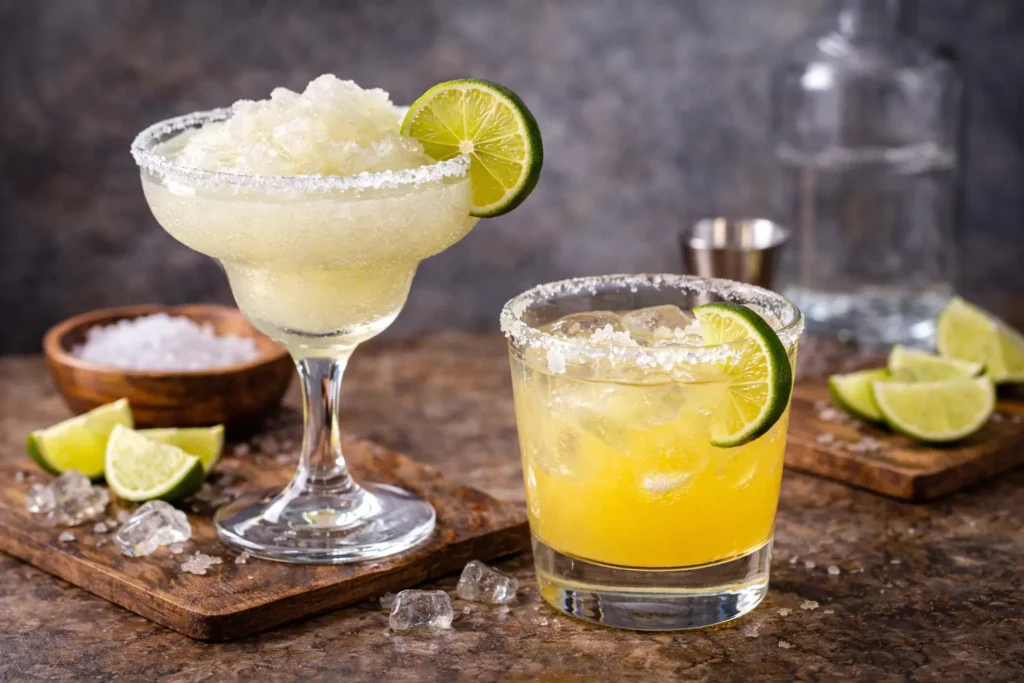
- Margarita glass for classic look
- Rocks glass for modern style
Chill the glass in the freezer first.
Salting the Rim Correctly
- Rub fresh lime around rim.
- Dip into coarse salt (only outer edge).
- Shake off excess.
Salt enhances sweetness and balances acidity. Avoid thick salt crusts.
Garnish
- Lime wheel
- Lime wedge
- Small fruit slices for variations
Keep it clean and simple.
Tips for Party Batching
Scaling a frozen margarita drink recipe requires precision.
For 8 servings:
- 16 oz tequila
- 8 oz lime juice
- 8 oz orange liqueur
Blend in batches with measured ice.
Do NOT pre-blend and let sit. Ice melts quickly.
If prepping ahead:
- Mix liquid ingredients.
- Refrigerate.
- Blend with ice just before serving.
This preserves texture and structure.
Why does this Recipe Often Fail at Home
Most failures come from misunderstanding dilution.
People treat frozen cocktails like smoothies. But a frozen margarita cocktail recipe follows cocktail structure first, texture second.
When you respect the 2:1:1 sour balance and control ice, you get:
- Bright citrus
- Clean agave expression
- Integrated sweetness
- Smooth, slushy consistency
Never watery.
Try this by yourself
Once you master this frozen margarita recipe, experiment confidently.
Test mango. Try a strawberry. Adjust the sweetness slightly based on fruit ripeness. Play with spice levels.
If you try a frozen mango margarita recipe or a frozen strawberry margarita recipe, I’d genuinely love to know which balance you preferred: brighter and citrus-forward or slightly sweeter and fruit-heavy?
That’s how real cocktail skill develops: tasting, adjusting, refining.
How This Article Was Created
This article is based on established cocktail structure principles, including the traditional 2:1:1 sour ratio widely taught in professional bartending programs and referenced in classic cocktail literature.
The techniques reflect standard hospitality training methods for dilution control, ingredient balance, and frozen drink preparation. No fabricated origin stories or unverified claims were included.
Every recommendation aligns with classic mixology fundamentals, professional bar practices, and real-world home bartending experience.
The goal is simple: help you make a frozen margarita cocktail recipe that tastes intentional, balanced, and consistently excellent.
Now grab your blender, and let’s do it properly.
Tell Your Story
One of the things I love most about a frozen margarita recipe is how personal it becomes. Everyone adjusts it slightly, a little more lime, less sweetness, extra spice, different fruit. That’s the beauty of mastering the structure first. Once you understand balance, you’re no longer guessing. You’re crafting.
If you try this frozen margarita cocktail recipe, I encourage you to pay attention to how it tastes before and after small adjustments.
Did you prefer it brighter?
Slightly sweeter?
More tequila-forward?
Maybe your frozen mango margarita recipe turned out richer than expected, or your frozen strawberry margarita recipe needed more lime to pop.
Cocktails aren’t just recipes. They’re sensory experiences. The more you experiment intentionally, the more confident you become behind the bar, even if that bar is your kitchen counter.
I’d genuinely love to hear which version becomes your signature frozen margarita drink recipe.
My Experience
I didn’t always get frozen margaritas right.
Early on, I made the same mistake most people make: I treated it like a smoothie. Too much ice. Too much blending. Not enough attention to dilution.
The result?
A drink that looked great but tasted flat and watery within minutes.
Everything changed when I started respecting the classic sour ratio and applying proper bartending fundamentals. Once I focused on balance, strong, sour, sweet, and dilution, the frozen margarita recipe became predictable in the best way. It tasted clean. Structured. Intentional.
Over time, I learned that frozen drinks require even more precision than shaken cocktails. Ice isn’t just texture; it’s an ingredient. Blending time matters. Fruit sweetness changes everything. Even glass temperature makes a difference.
Now, when I make a frozen margarita cocktail recipe, I don’t rely on guesswork. I rely on structure. And that structure consistently produces a smooth, slushy margarita that never turns watery halfway through the glass.
Final Thoughts
A truly great frozen margarita recipe is simple, but not careless.
It respects fresh lime juice. It uses quality tequila. It controls dilution. It balances sweetness properly. And most importantly, it follows the time-tested sour cocktail framework that professionals rely on.
Whether you’re making a classic version, a frozen mango margarita recipe, or a frozen strawberry margarita recipe, the principles stay the same. Balance first. Texture second. Adjust thoughtfully.
If you approach your margarita drink recipe frozen with that mindset, you’ll never end up with a sugary slush again.
Make it fresh. Blend it briefly. Serve it immediately.
And enjoy every perfectly chilled sip.
Faqs
What is the difference between a margarita and a frozen margarita?
The main difference between a margarita and a frozen margarita is texture and preparation method. A classic margarita is typically shaken with ice and then strained into a salt-rimmed glass, served either “straight up” (without ice) or “on the rocks” (over ice). It has a smooth, liquid consistency.
A frozen margarita, on the other hand, is blended with ice until it reaches a slushy texture, similar to a frozen cocktail or smoothie. The ingredients are usually the same: tequila, orange liqueur, and fresh lime juice, but the blending process creates a thicker, icy drink. Frozen margaritas are especially popular in warm climates and during summer because of their refreshing texture.
What is the golden rule margarita?
The “golden rule” margarita commonly refers to the balanced ratio of ingredients that creates the ideal flavor profile: 2 parts tequila, 1 part orange liqueur, and 1 part fresh lime juice. This balance ensures the drink is neither too sour nor too sweet.
The golden rule focuses on proportion rather than specific brands. A well-balanced margarita highlights the tequila while maintaining freshness from lime juice and subtle sweetness from orange liqueur. Many professional bartenders consider this ratio the foundation of a properly made margarita.
What was the first recipe for a margarita?
The exact origin of the margarita is debated, but one of the earliest documented recipes appeared in the December 1953 issue of Esquire. That published recipe included tequila, triple sec, and lime juice, the same core ingredients used today.
Several origin stories exist, including claims from bartenders in Mexico and the United States during the 1930s and 1940s. While no single inventor has been definitively confirmed, the classic combination of tequila, orange liqueur, and lime juice has remained consistent since the mid-20th century.
What is the 2:1:1 rule in bartending?
The 2:1:1 rule in bartending is a standard cocktail ratio that means:
- 2 parts base spirit
- 1 part sweet ingredient
- 1 part sour ingredient
This formula creates a balanced cocktail with structure and harmony. In a margarita, tequila is the base spirit (2 parts), orange liqueur provides sweetness (1 part), and fresh lime juice provides sourness (1 part).
The 2:1:1 ratio is widely used beyond margaritas and serves as a reliable guideline for building many classic cocktails. It helps maintain consistency and balance, which are essential in professional bartending.
What is a substitute for Cointreau in margaritas?
If you do not have Cointreau, several good substitutes work well in margaritas:
- Triple sec: A general category of orange liqueur that provides similar citrus sweetness.
- Grand Marnier: A richer, cognac-based orange liqueur that adds depth and slight oak notes.
- Other quality orange liqueurs. Any well-made orange liqueur can replace Cointreau while maintaining the drink’s balance.
When substituting, use the same amount as you would Cointreau. Keep in mind that different orange liqueurs vary in sweetness and alcohol content, so slight adjustments may be needed depending on taste preference.
References
Industry-standard professional margarita ratios
Classic margarita preparation and ingredient tips
Frozen margaritas (origin, balance, and technique context)

MargaritaLab.com is created and managed by Muhammad Hussain, an SEO specialist with several years of experience in research-driven content creation. With a focus on the Margarita Recipe niche, he combines data-backed insights, careful testing, and clear explanations to make margarita recipes easy to understand and enjoyable for readers at every level.