|
Getting your Trinity Audio player ready... |
Most store-bought margarita mixes taste dull for the same reason, pasteurization kills the bright citrus compounds in fresh lime juice, and manufacturers cover for it with sugar. After testing eight mixes side by side using the same blanco tequila, the same 2:1 ratio, and no fresh lime added, the difference between the best and worst bottles was larger than I expected. One mix had four clean ingredients and cost $9. Another had no real lime juice at all and still outsells everything on this list. Here’s what I found.
Why Store-Bought Mixes Taste Dull: The Pasteurization Problem
Before you blame the brand, understand the process.
Almost every store-bought margarita mix is pasteurized before it hits the shelf. Pasteurization involves briefly heating the liquid to kill bacteria and extend shelf life, which is fine for milk, but damaging for citrus. The heat breaks down the volatile compounds in fresh lime juice that create brightness and aroma. What’s left is a flatter, slightly bitter version of the original flavor.
To compensate for that lost brightness, most manufacturers do one of two things: they add more sugar to mask the dullness, or they add artificial lime flavoring to fake the freshness. Both approaches produce the same result, a mix that tastes like lime candy rather than a real margarita.
The mixes that actually work are the ones that compensate differently. Instead of masking the pasteurization problem, they build flavor around it, using agave nectar for a softer sweetness, adding orange juice for citrus complexity, or keeping the sugar low enough that the tequila still comes through.
That’s what I was looking for when I tested these eight brands.
How to Read a Margarita Mix Label Before You Buy
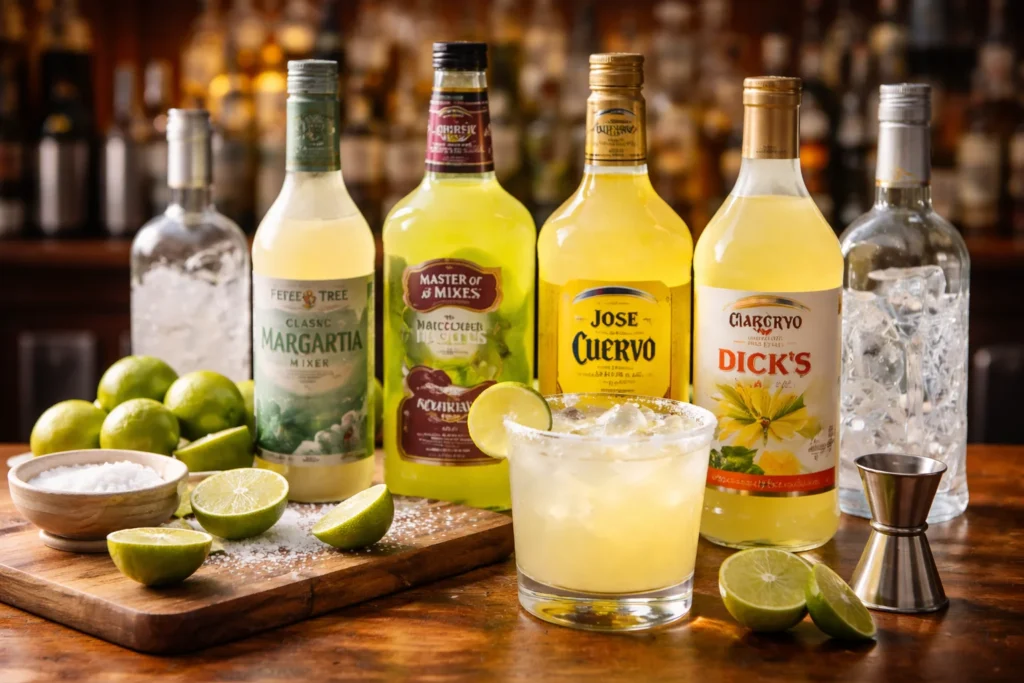
You can tell a lot about a mix before you open it. Here’s what to look for on the ingredients label.
Real lime juice vs citric acid. Real lime juice will appear as “lime juice” or “lime juice concentrate.” Citric acid is a cheap substitute that provides sourness without any of the flavor complexity of real citrus. If citric acid appears before lime juice in the list, put the bottle back.
Sweetener type. Agave nectar and cane sugar produce a cleaner sweetness that doesn’t linger. High-fructose corn syrup produces a heavier, more artificial sweetness that coats your mouth. Avoid any mix where HFCS is the primary sweetener.
Where water appears. Water is fine in a mix, but if it’s the first ingredient, the mix is heavily diluted and you’ll need more of it to get any flavor, which means more sugar per drink than the label suggests.
Artificial colors and flavors. A yellow or green color in a lime mix is usually artificial. Real lime juice concentrate produces a pale, slightly murky color. Bright neon green is always a bad sign.
Calorie count per serving. Anything above 100 calories per 4 oz serving is sugar-heavy and will likely make your margarita taste sweet rather than balanced.
How I Tested These Mixes
Every mix was tested the same way: 3 oz of mix to 2 oz of blanco tequila, shaken for 15 seconds with ice, and strained into a rocks glass. No fresh lime added, no adjustment to the ratio, the point was to taste each mix as it performs out of the bottle.
I scored each brand on four criteria:
- Citrus clarity: does it taste like lime, or like lime candy?
- Sweetness balance: does the sweetness support the drink or overwhelm it?
- Tequila integration: does the mix work with the tequila, or fight it?
- Would I buy it again?: the only question that actually matters
Tequila used: Espolón Blanco. Consistent throughout.
The Mixes Ranked: Worst to Best
8. Stirrings Simple Margarita Mix
The problem: Almost no flavor at all.
Stirrings markets itself as a low-calorie option, and that’s true, but it achieves low calories by removing most of the flavor along with the sugar. The lime is barely present, the sweetness is whisper-thin, and when you add tequila, the spirit completely takes over because there’s nothing in the mix strong enough to balance it.
If your priority is calories above all else, this technically works. If your priority is a margarita that tastes like a margarita, keep looking.
Citrus clarity: Low | Sweetness balance: Low | Best use: Calorie-conscious mixing only
7. Master of Mixes Handcrafted Margarita Mixer
The problem: Too sweet, too thick, not enough acid.
The “handcrafted” label is doing a lot of heavy lifting here. This mix has a thick, almost syrupy consistency and a sweetness level that overpowers everything else. The lime flavor is present but buried under sugar before it can register. When you add tequila, you get a sweet citrus drink, not a margarita.
The fix, if you’re stuck with a bottle, is to add half an ounce of fresh lime juice and reduce the mix by half an ounce. It brings the acid back into range and makes it drinkable.
Citrus clarity: Medium | Sweetness balance: Very High | Best use: Works for sweet-preferring drinkers if you reduce the quantity
6. Barsmith Triple Citrus Margarita Mix
The problem: Interesting concept, uneven execution.
Barsmith uses three citrus sources, lime, lemon, and orange, which should, in theory, produce more complexity than a single-lime mix. In practice, the lemon note is too prominent and pushes the flavor profile away from margarita territory toward something closer to a sour mix. It’s not bad, but it doesn’t taste like the drink you ordered.
The orange element is subtle and pleasant. If Barsmith reduced the lemon and increased the orange, this would be a mid-tier contender.
Citrus clarity: Medium | Sweetness balance: Medium | Best use: Experimental mixing, not classic margaritas
5. Jose Cuervo Classic Margarita Mix
The problem: Inoffensive, but the ingredients list is hard to defend.
Jose Cuervo’s mix has been on liquor store shelves for decades, and the brand recognition means a lot of people default to it. The flavor is recognizable as a margarita. It’s not too sweet, not too sour, and it mixes cleanly with tequila.
The problem is what’s in it: no real lime juice, high-fructose corn syrup as the primary sweetener, and artificial flavors throughout. You’re tasting a simulation of a margarita rather than the real thing. It works well enough for casual parties where nobody is paying close attention, but it won’t satisfy anyone who actually cares about what’s in the glass.
Citrus clarity: Medium | Sweetness balance: Medium-High | Best use: High-volume casual parties
4. Fever-Tree Classic Margarita Mix
The strength: Good balance, but an unexpected flavor note divides opinion.
Fever-Tree uses real Mexican lime and agave syrup, which immediately puts it ahead of Jose Cuervo on ingredient quality. The lime-to-sweet ratio is genuinely well calibrated, this is one of the few mixes where neither element dominates the other.
The issue is a noticeable spice note, somewhere between ginger and warm baking spice, that comes through distinctly in the finish. For some people this is a welcome complexity. For others it reads as off-flavor. If you prefer a clean, classic lime margarita, this might surprise you in the wrong direction. If you like margaritas with a bit of warmth, it’s excellent.
Citrus clarity: High | Sweetness balance: Medium | Best use: Anyone who likes a slightly warming, complex margarita
3. Tres Agaves Classic Lime Margarita Mix
The strength: Four ingredients, nothing artificial, genuinely tastes fresh.
Tres Agaves contains: water, organic agave nectar, organic lime juice concentrate, and ascorbic acid (vitamin C, used to preserve freshness). That’s it. The simplicity shows in the glass, the lime flavor is clean and bright, the agave sweetness is soft without being cloying, and the tequila integrates naturally rather than fighting the mix.
At around $9 for a liter, this is also the best value on the list. The only reason it sits at three rather than higher is that it’s slightly one-dimensional, there’s no complexity beyond lime and sweet. For a classic margarita, that’s exactly what you want. For something with more depth, you’ll want one of the top two.
Citrus clarity: High | Sweetness balance: Medium-Low | Best use: Everyday classic margaritas, the best value pick
2. Stonewall Kitchen Margarita Mixer
The strength: The addition of orange juice solves the complexity problem.
Stonewall Kitchen’s mix uses lime juice, cane sugar, and orange juice, and that last ingredient makes a meaningful difference. The orange juice adds a layer of citrus complexity that pure lime mixes can’t achieve, which is closer to the flavor profile of a properly made margarita (which should always include an orange liqueur element).
The sweetness level is higher than Tres Agaves, but it’s a balanced sweetness rather than a cloying one. This is the best mix on the list for drinking straight as a mocktail, and it’s equally good once tequila is added. The orange note doesn’t overpower; it supports.
Citrus clarity: High | Sweetness balance: Medium | Best use: When you want a fuller-flavored margarita with more dimension
1. Dick’s Classic Margarita Mixer
The strength: The closest thing to a fresh margarita in a bottle.
Dick’s uses lime juice, agave, orange juice, and cucumber. The cucumber is the unexpected element, and it works: it adds a cooling, slightly savory note that cuts the sweetness and creates a finish that actually resembles a bar-quality drink. This is the only mix on the list that doesn’t taste like it was made to be shelf-stable, it tastes like someone made it fresh.
The flavor is bold and slightly bitter, which means it won’t appeal to everyone. If you like sweet, fruity margaritas, this is not your mix. If you want a drink that tastes like you squeezed the limes yourself, this is the closest a bottle will get you.
Citrus clarity: Excellent | Sweetness balance: Low-Medium | Best use: Anyone who prioritizes fresh flavor over sweetness
The Comparison
| Mix | Real Lime Juice | Sweetener | Citrus Clarity | Sweetness Level | Best Use |
| Dick’s Classic Margarita Mixer | Yes | Agave | Excellent | Low-Medium | Fresh-tasting classic |
| Stonewall Kitchen Margarita Mixer | Yes | Cane Sugar | High | Medium | Fuller-flavored margaritas |
| Tres Agaves Classic Lime Margarita Mix | Yes (concentrate) | Agave | High | Medium-Low | Best value everyday option |
| Fever-Tree Classic Margarita Mix | Yes | Agave | High | Medium | Complex, warming profile |
| Jose Cuervo Classic Margarita Mix | No | HFCS | Medium | Medium-High | High-volume casual use |
| Barsmith Triple Citrus Margarita Mix | Yes | Cane Sugar | Medium | Medium | Experimental mixing |
| Master of Mixes Handcrafted | Yes (concentrate) | Cane Sugar | Medium | Very High | Sweet-preference drinkers |
| Stirrings Simple Margarita Mix | Yes | Low-calorie sweetener | Low | Very Low | Calorie-restricted only |
Best Mix by Category
Best Overall
Dick’s Classic Margarita Mixer The cucumber and orange juice give it a complexity that no other mix on the list achieves. It’s the only one that doesn’t taste like a compensation for fresh ingredients, it tastes like an intentional drink in its own right.
Best Budget (Under $10)
Tres Agaves Classic Lime Margarita Mix Around $9 per liter, four clean ingredients, no HFCS, and a flavor that holds up next to mixes costing twice as much. If you’re stocking for a party and don’t want to think about it, buy this.
Best for a Crowd
Jose Cuervo Classic Margarita Mix The ingredients aren’t impressive, but it’s widely available, inexpensive in large quantities, and produces a recognizable margarita flavor that doesn’t offend anyone. For 30 people who want something cold and citrusy, it does the job.
Best Low-Calorie
Stirrings Simple Margarita Mix The only legitimate low-calorie option tested. The flavor is thin, so pair it with a high-quality blanco tequila that can carry the drink on its own, the mix is there for balance, not flavor.
Best for Someone Who Hates Sweet
Dick’s Classic Margarita Mixer The cucumber note and low sweetness level make this the least candy-like mix on the list. If every margarita mix you’ve tried has tasted like dessert, start here.
How to Rescue a Mix That Tastes Off
You bought a bottle and it’s not working. Here’s how to fix the three most common problems without starting over.
If it’s too sweet: Add fresh lime juice, half an ounce at a time, until the acidity comes back into balance. Also reduce the mix quantity by about a quarter and replace it with water to dilute the sweetness without losing volume. A small pinch of salt on the rim also suppresses perceived sweetness.
If it’s too flat or dull: The pasteurization killed the bright top notes. Add a half-ounce of fresh lime juice and a quarter-ounce of orange liqueur (Cointreau works best). The fresh citrus oils in the lime and the orange complexity in the liqueur rebuild what the pasteurization removed.
If the tequila is fighting the mix: This usually means the mix is too weak, either too watery or too low in acid, so the tequila has nothing to integrate with. Add more mix (not more tequila), and shake harder and longer to create proper dilution. A properly diluted margarita at around 20–22% ABV in the glass is where tequila and mixers stop fighting and start cooperating.
If it tastes artificial: There’s no fixing an artificial flavor base. Cut your losses, use the bottle for frozen margaritas where blended ice and fruit can mask the artificial notes, and buy a different brand next time.
The One Upgrade That Improves Any Mix
Squeeze half a fresh lime into the shaker before you add the mix.
That’s it. Not a technique, not a different brand, not an expensive liqueur, just half a fresh lime.
The volatile aromatic compounds in fresh lime zest and juice are exactly what pasteurization destroys. Adding fresh lime at the last moment before shaking reintroduces those compounds and transforms even a mediocre mix into something that smells and tastes like a real drink. The improvement is immediate and dramatic with every mix on this list, including the ones ranked at the top. If you do nothing else with what you read here, do this.
Frequently Asked Questions
What is the best store-bought margarita mix?
The best store-bought margarita mix is one that uses real lime juice, balanced sweetness, and minimal artificial ingredients. A good mix should taste fresh, not overly sugary, and allow the tequila to still come through.
Can store-bought margarita mix taste like a real margarita?
Yes, it can come close, especially if you improve it slightly. Adding fresh lime juice, using quality tequila, and shaking properly can make a big difference in achieving a more authentic flavor.
How can I improve store-bought margarita mix?
The easiest way is to add fresh lime juice to boost acidity and freshness. You can also use better tequila and add a small amount of orange liqueur for more depth and balance.
Is margarita mix better than fresh ingredients?
Fresh ingredients almost always produce a better margarita because they offer brighter and more natural flavors. However, a high-quality mix can be a convenient alternative when you don’t have time to juice limes.
Why do some margarita mixes taste too sweet?
Many mixes rely on high sugar content or corn syrup, which can overpower the citrus flavor. You can fix this by reducing the amount of mix and adding fresh lime juice to rebalance the drink.
Do I need to add tequila to margarita mix?
Yes, most margarita mixes are non-alcoholic and require tequila to complete the drink. A common starting ratio is about 2 parts tequila to 3–4 parts mix, adjusted to your taste.
Can I make a margarita without triple sec using a mix?
Yes, most mixes already include some orange flavor. However, adding a small amount of triple sec or another orange liqueur can enhance the citrus complexity and improve the overall taste.
What is the best way to serve a margarita made with a mix?
Serve it over ice in a rocks glass with a lightly salted rim. Always shake the drink with ice before serving to ensure proper dilution and a smoother, more balanced texture.
References
Classic Margarita Ratio & Balance
International Bartending Standards
Importance of Fresh Lime Juice vs Mix
Historical Reference / Cocktail Literature

Muhammad Hussain is the creator of MargaritaLab.com, where he tests and analyzes margarita recipes, ingredients, and techniques to help readers make better drinks at home. Over time, he has experimented with different tequila types, lime juice variations, and store-bought mixes to understand what actually makes a balanced margarita.
His approach combines hands-on testing with detailed research, focusing on real-world results rather than theory. Whether comparing fresh vs bottled lime juice or reviewing popular margarita mixes, his goal is to simplify the process and share what truly works.
Pingback: How Much Sugar Is Really in a Margarita? The Numbers, Ingredient by Ingredient