|
Getting your Trinity Audio player ready... |
People ask me this question, expecting a simple answer. Frozen or classic, pick one.
The honest answer is that it depends on what you are actually trying to drink. Not in the vague “it’s personal preference” way that most comparison articles hide behind, but in a specific and testable way. The same recipe produces two genuinely different sensory experiences depending on how you prepare it. Understanding why is more useful than just picking a side.
I have made both versions hundreds of times and tested them side by side with identical ingredients. What I found surprised me in a few ways. The differences go much deeper than texture.
The Real Question Nobody Asks About These Two Drinks
Most people frame this as a comfort question. Do you prefer sipping something elegant or slurping something slushy?
That framing misses the more interesting question entirely.
If you make a frozen margarita and a classic margarita with literally the same tequila, the same lime juice, the same orange liqueur, and the same ratios, they will taste different. Noticeably different. Not because of the preparation method. Because of physics.
Cold temperature suppresses sweetness and aroma. Dilution changes alcohol perception. Texture changes how quickly you taste different flavour compounds. These are not preference differences, they are sensory differences with real explanations.
Once you understand those differences, choosing between them becomes a deliberate decision rather than a default habit.
Why They Taste Different Even With Identical Ingredients
This is the section that changed how I think about both drinks.
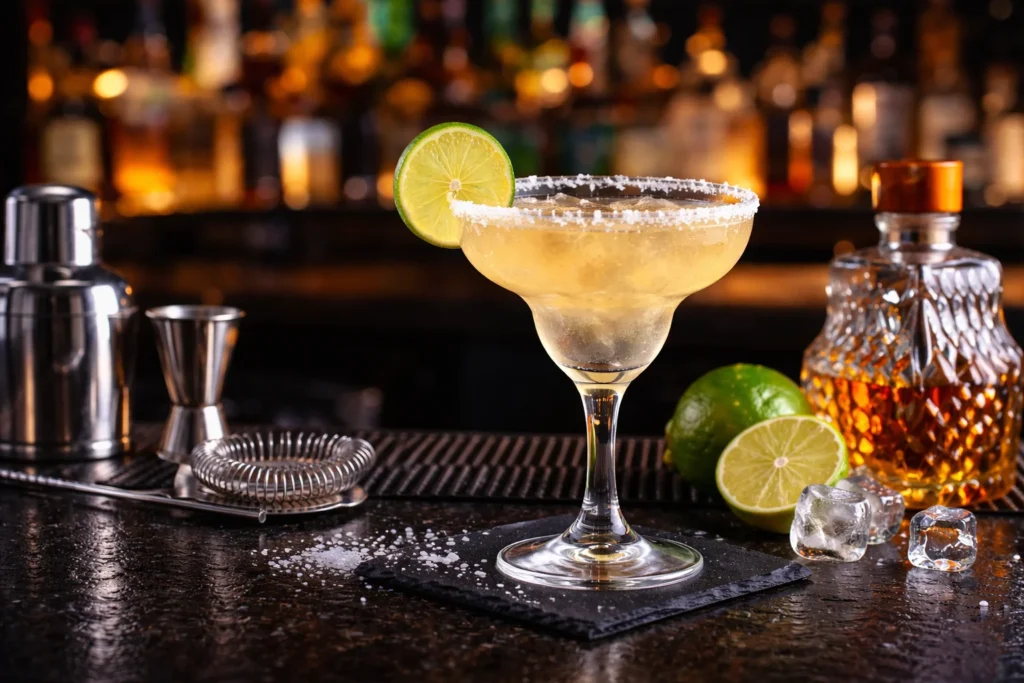
I made two margaritas back to back with the same specs: 2 oz blanco tequila, 1 oz Cointreau, 1 oz fresh lime juice. One shaken over ice and strained. One blended with ice.
The shaken version tasted sharper, more aromatic, and more clearly like tequila. The blended version tasted softer, slightly sweeter, and the tequila was noticeably less prominent.
Same ingredients. Same proportions. Different drinks.
The explanation comes down to three things happening simultaneously in the frozen version that do not happen in the classic.
How Cold Temperature Suppresses What You Taste
Temperature directly affects taste perception in measurable ways.
Sweetness perception decreases significantly at lower temperatures. This is why ice cream tastes less sweet when frozen solid than when slightly melted. The same thing happens in a frozen margarita, the agave or triple sec sweetness becomes less prominent, which can make the drink feel more balanced to some people and thinner to others.
Aroma perception also decreases with cold. The aromatic compounds in good tequila, the grassy, citrusy, peppery notes that make blanco tequila interesting, volatilise more slowly at freezing temperatures. This is why a premium tequila that tastes vibrant and complex in a classic margarita can become almost invisible in a frozen version. The tequila is still there. You just cannot smell it as easily, and smell is responsible for most of what we perceive as flavour.
This has a practical implication that most recipes ignore: a frozen margarita built with the same ratios as a classic margarita will taste less sweet and less tequila-forward. If you want a frozen version that tastes as balanced as your classic recipe, you need to adjust. Specifically, you need slightly more sweetener and a tequila with enough intensity to survive cold suppression.
Dilution: How Each Style Changes the Drink Differently
Both styles dilute the cocktail with water from ice. The mechanism is completely different and the results diverge significantly.
Shaking a classic margarita over ice for ten to twelve seconds adds a controlled and predictable amount of dilution. After that, the dilution stops, and the drink is strained into a glass. The remaining ice slowly melts in the glass, adding a small amount of water over time. The dilution curve is gentle and manageable.
A frozen margarita blends ice directly into the drink, incorporating a much larger volume of water immediately. The dilution is front-loaded and significant. Then, as the drink sits in the glass, it continues melting, and unlike a strained classic margarita, the ice in a frozen version is distributed throughout the entire drink rather than sitting separately. The entire drink becomes progressively more diluted as you consume it.
This explains why frozen margaritas often taste noticeably weaker by the bottom of the glass. It is not that you drank through the alcohol; it is that the continuing melt added more water to what was already a more diluted starting point.
Ice cube size also matters for on-the-rocks versions in ways people underestimate. Large format ice cubes melt significantly more slowly than standard cubes because of their lower surface-area-to-volume ratio. A classic margarita served over one large cube will taste sharper and less diluted twenty minutes into drinking than the same drink served over crushed ice. This is worth thinking about when you are making on-the-rocks versions at home.
The Texture Question: What Frozen Should Actually Feel Like
Texture is the most immediately noticeable difference between the two styles and also the most misunderstood.
A properly made frozen margarita should pour slowly but still flow, thicker than a liquid but not as thick as a slushie from a gas station. If you tilt the glass and nothing moves, you have blended too long or used too much ice. If it pours immediately like water, the texture has already collapsed from over-blending.
The correct consistency I aim for is what I call the slow pour test: tilt the glass at 45 degrees and the drink should begin moving after about two seconds, not immediately.
Getting there consistently requires understanding the relationship between ice quantity and liquid volume. Most people use too much ice, which creates an icy, grainy texture that falls apart fast. Reducing ice by about a quarter of what feels instinctive and blending for shorter than feels necessary gets you closer to the right result.
Blend in short pulses rather than one continuous run. Five to seven seconds per pulse, stopping to check consistency between each. This gives you much more control than running the blender continuously until it sounds smooth.
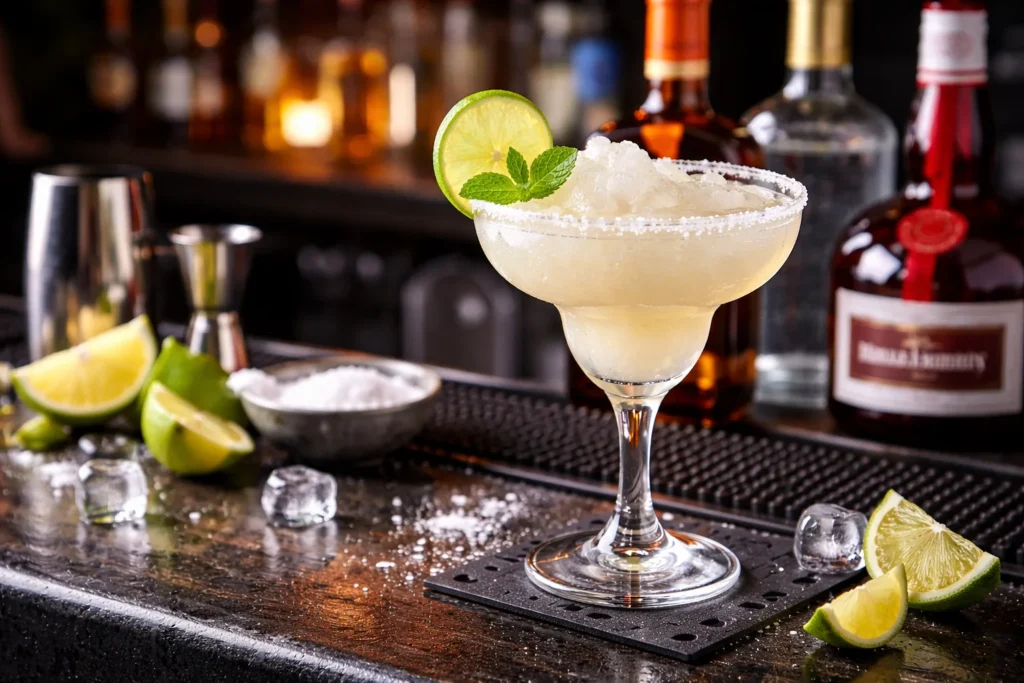
Frozen vs Classic Margarita: The Real Difference
Classic Margarita
- Crisp and refreshing
- Balanced and sharp
- Gradual dilution
- More “cocktail-forward”
Frozen Margarita
- Slushy and smooth
- Colder and more refreshing in hot weather
- Immediate dilution
- Slightly muted flavors
My Take
If I want precision and full control over flavor, I go with a classic margarita. I like how clearly you can taste each element; the tequila, the lime, and the orange liqueur all stay distinct, and it’s easier to adjust if something feels off.
But when I’m in the mood for something more relaxed or refreshing, especially in warmer weather, I reach for a frozen margarita. The texture makes it easier to drink, and it works better when I’m not focusing on perfect balance and just want something smooth and cooling.
I’ve also noticed that frozen margaritas tend to work better for guests. Most people find them more approachable, while a classic margarita can sometimes feel too sharp if the balance isn’t right.
So for me, it really comes down to context:
- If I’m making a drink for myself and want it just right: classic
- If I’m making drinks for a group or want something easy: frozen
There’s no single winner here, just different choices depending on what you want from the drink.
When to Choose Frozen vs Classic Margarita
Over time, I realized that choosing between a frozen vs classic margarita isn’t just about taste, it’s about the situation.
Choose a Classic Margarita When:
- You want a clean, balanced cocktail
- You’re pairing with food (especially salty or spicy dishes)
- You care about flavor clarity and tequila quality
- You’re hosting a more refined or dinner-style gathering
A classic margarita lets each ingredient shine. It’s sharper, more expressive, and closer to traditional cocktail standards.
Choose a Frozen Margarita When:
- It’s hot and you want something ultra-refreshing
- You’re serving a crowd casually
- You want a fun, easy-drinking experience
- You’re adding fruit flavors like mango or strawberry
Frozen margaritas are more about texture and refreshment than precision.
My Rule of Thumb
If I want to taste the margarita, I go classic.
If I want to experience the margarita, I go frozen.
Frozen vs Classic Margarita: The Real-World Comparison
After making both versions multiple times, these differences became very noticeable in real use
| Feature | Classic Margarita | Frozen Margarita |
|---|---|---|
| Flavor Clarity | Sharp, bright, each ingredient stands out | Softer, flavors blend together |
| Sweetness Perception | Balanced if ratio is right | Often feels sweeter due to dilution |
| Texture | Clean, liquid, crisp | Thick, slushy, smooth |
| Dilution Control | Easy to control by shaking time | Harder to control (melts quickly) |
| First Sip Experience | Strong and vibrant | Smooth and easy |
| After 5–10 Minutes | Slightly mellow, still balanced | Can become watery if not finished |
| Ease of Making | Simple, quick, consistent | Requires blender + balance |
| Room for Error | Low (mistakes are noticeable) | Higher (texture hides flaws) |
| Best Use Case | When you want precision and control | When you want something refreshing and casual |
| Guest Preference (in my experience) | Mixed, some find it strong | More widely liked |
Does the Same Tequila Work for Both?
This surprised me during testing and contradicts what most guides recommend.
The conventional answer is that blanco tequila works for both styles. That is mostly correct but incomplete.
For a classic margarita, you want a tequila with clear aromatic character, herbal, citrusy, or peppery notes that stay noticeable through shaking and come through in the glass. Premium blanco tequilas shine here because their complexity is fully accessible.
For a frozen margarita, cold temperature suppresses those same aromatic notes significantly. A tequila that tastes beautifully complex in a classic margarita can become almost flavourless in a frozen version because the cold simply will not let the aromatics reach your nose. For frozen versions, I find that a tequila with more aggressive flavour intensity holds up better, something with more pronounced pepper or agave character that survives the cold suppression.
Aged tequilas, reposado and añejo, present an interesting consideration for frozen versions. The barrel-derived complexity of a good reposado, all those vanilla and caramel notes that develop from oak contact, gets significantly suppressed by cold and dilution. You lose the very thing you paid more for. For frozen margaritas specifically, this makes blanco tequila the practical choice not just by preference but by physics. For a classic margarita where aromatics survive intact, a reposado can add a genuinely interesting dimension.
Classic Margarita Recipe
This is the version I keep returning to as my standard because every ingredient stays clearly present throughout the drink.
Ingredients
- 2 oz blanco tequila Something with clear agave and citrus character, this is where the tequila actually shows itself.
- 1 oz fresh lime juice Fresh only. Bottled lime juice changes the character of a classic margarita more obviously than it does in any frozen version because there is nowhere for the artificial notes to hide.
- ¾ oz Cointreau Dry orange character without excessive sweetness. The ratio to lime matters here, too much Cointreau and the drink softens; too little and it turns thin.
- Small pinch of kosher salt in the shaker Not enough to taste salty. Enough to sharpen flavour definition.
- Ice for shaking, fresh ice for serving
Instructions
Add tequila, lime, Cointreau, and salt to a shaker filled with ice.
Shake hard for 10 to 12 seconds. Not longer. Over-shaking dilutes the drink past the point where the tequila stays prominent.
Strain into a half-salt-rimmed rocks glass over fresh ice. The double strain is worth doing; it removes ice chips that accelerate dilution.
Serve immediately and drink within fifteen minutes while the balance holds.
Frozen Margarita Recipe
For a frozen version to taste as balanced as the classic, the ratios need adjustment for the reasons explained above.
Ingredients
- 2 oz blanco tequila Choose a more intensely flavoured blanco than you might for a classic version, the cold will suppress aromatics significantly.
- 1 oz fresh lime juice. Same as classic, fresh matters here too, perhaps more so because frozen versions are consumed more slowly and the lime notes need to hold up longer.
- 1 oz Cointreau Slightly more than the classic version to compensate for cold suppression of sweetness.
- ¼ oz agave syrup Often needed in frozen versions even when the same classic recipe works without it, again because of cold sweetness suppression.
- 1 to 1½ cups ice Less than instinct suggests. Start with one cup and add more only if the texture needs it after the first blend.
Instructions
Add all liquid ingredients to the blender first, then ice last. This sequence helps the liquids distribute evenly around the ice before blending begins rather than the ice clumping in a dry pocket.
Blend in short pulses of five to seven seconds each, checking consistency between pulses.
The target texture: pours slowly when tilted, holds its shape briefly in the glass, does not immediately liquify.
Pour into a chilled glass, a cold glass slows the melt significantly and extends the window where the drink tastes its best.
The Blending Consistency Test
This is the quickest way to know if the frozen version is right before you pour it.
Tilt the blender jar. If the contents do not move at all, blend again for a few seconds with a tiny splash of cold water, not more ice. If the contents pour out immediately like liquid, the texture has already collapsed, and there is no recovery from this. Start over with less ice next time.
If it moves slowly and holds some shape after tilting, it is ready.
Why Ice Quality Changes Both Drinks More Than Most People Realise
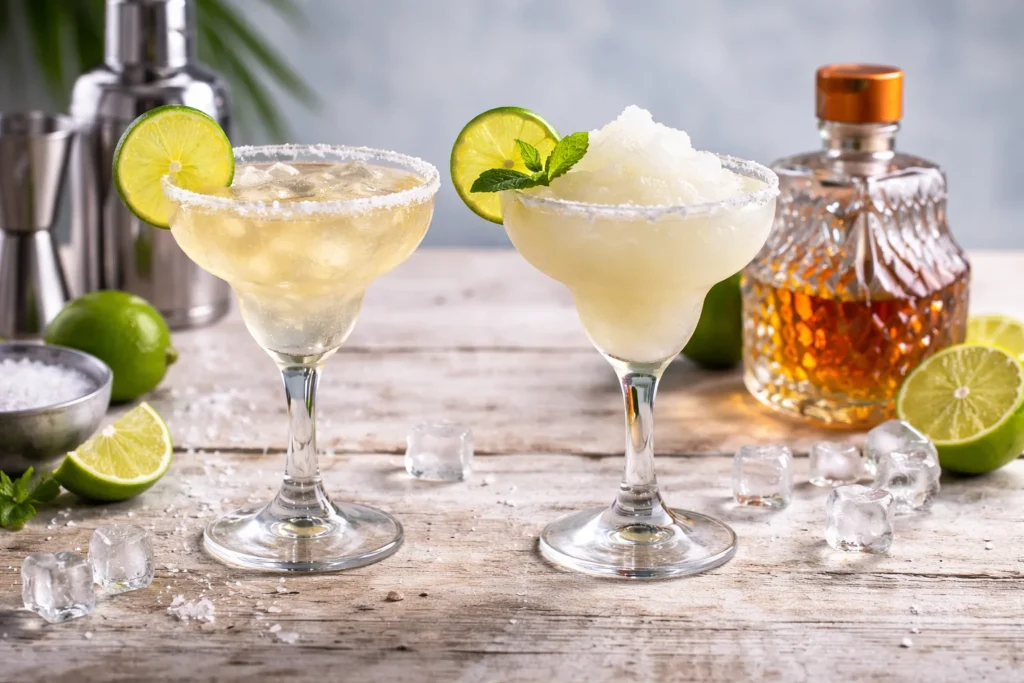
Ice is an ingredient in both versions, not just a cooling mechanism. Its quality affects flavour in ways that are immediately noticeable once you start paying attention.
Cloudy ice contains trapped air and impurities that give off-flavours to a cocktail as they melt. Clear ice melts more cleanly and adds only water. This matters more in a classic margarita than a frozen one because the melt from clear ice in a rocks glass is gradual and the water it adds is tasteless. Cloudy ice in the same situation adds subtle off-notes that accumulate over the life of the drink.
For frozen versions, the ice is blended into the drink entirely, so its quality affects the overall flavour from the first sip. I notice the difference most clearly in head-to-head tests, the same recipe with clear ice versus standard freezer ice tastes cleaner, and the lime notes stay brighter throughout.
The practical takeaway: fill ice trays with filtered water and freeze slowly in the back of the freezer. This produces clearer, denser ice without buying specialised equipment.
My 10-Second Balance Test
This works for both styles and I use it before every batch.
Take a small sip before serving or pouring. Hold it on your tongue for about ten seconds. In that time, you should be able to identify at least three distinct things: tequila, citrus, and something sweet or softening. If you can only identify one or two, the balance is off.
For a classic margarita that fails the test: if tequila dominates, add a few more drops of lime. If citrus dominates, add a small dash of agave. If it tastes flat and sweet, add more lime.
For a frozen margarita that fails the test: if it tastes like flavoured ice with no clear identity, either the tequila was too delicate for the cold, the dilution is too high, or both. These are harder to rescue once blended, adjust the recipe for the next batch rather than trying to fix the current one.
Faqs
Can I make a margarita without triple sec?
Yes, you can substitute triple sec with other orange liqueurs like Cointreau or Grand Marnier. You can also use a small amount of agave syrup with fresh orange juice, but the flavor profile will change slightly.
Is it better to salt the rim of a margarita?
Salting the rim is optional but recommended. Salt enhances the citrus flavor, reduces bitterness, and balances the drink. Many people prefer salting only half the rim to control each sip.
Should margaritas be shaken or blended?
Classic margaritas should be shaken to properly chill and dilute the drink while maintaining balance. Frozen margaritas should be blended to create a slushy texture. The method depends on the style you want.
What is the best tequila for margaritas?
Blanco (silver) tequila is the best choice for margaritas because of its clean and crisp flavor. Reposado tequila can also be used for a slightly smoother and richer taste, but heavily aged tequilas are usually not recommended as they can overpower the drink.
Does a frozen margarita taste weaker than a classic margarita?
Yes, a frozen margarita can taste slightly weaker because blending ice dilutes the drink more quickly. This softens the alcohol intensity compared to a classic margarita, where dilution happens more gradually.
References
Classic Margarita Ratio (2:1:1 Standard)
Cocktail Balance (Sour Structure Principle)
Why Margaritas Are Shaken (Dilution & Texture)

Muhammad Hussain is the creator of MargaritaLab.com, where he tests and analyzes margarita recipes, ingredients, and techniques to help readers make better drinks at home. Over time, he has experimented with different tequila types, lime juice variations, and store-bought mixes to understand what actually makes a balanced margarita.
His approach combines hands-on testing with detailed research, focusing on real-world results rather than theory. Whether comparing fresh vs bottled lime juice or reviewing popular margarita mixes, his goal is to simplify the process and share what truly works.
Pingback: Shaken vs Blended Margarita: What Ice Actually Does to Your Drink
Pingback: Grand Marnier vs Triple Sec vs Cointreau: Which Orange Liqueur Actually Makes a Better Margarita?
Pingback: Triple Sec vs Cointreau for Margaritas: What the Bottle Label Does Not Tell You