|
Getting your Trinity Audio player ready... |
A good Mango Margarita Recipe sounds easy on paper. Tequila, lime, mango, done. That is exactly why so many of them disappoint.
After testing this drink with fresh Ataulfo mangoes, Tommy Atkins, frozen supermarket chunks, canned pulp, and commercial puree, I realized the real problem is never the tequila. It is texture. Mango behaves differently from almost every fruit commonly used in margaritas. Depending on the type of mango and whether it is fresh, frozen, or pureed, you can end up with a cocktail that tastes rich and tropical but drinks like baby food.
The biggest decision in this drink is not fresh versus frozen because either can work. The real question is this: do you want a bright, sharp margarita with mango flavor, or a thick mango cocktail with tequila hidden somewhere inside it? Those are two very different drinks, and one ingredient decision completely shifts the result.
The Mango Problem Nobody Explains Before You Start
Mango behaves more like a puree than a juice. Even when fully ripe, it contains far more flesh and fiber than fruits like strawberry or pineapple and far less natural sharpness.
That matters because margaritas rely on contrast. Tequila, citrus, orange liqueur, salt, everything is supposed to stay distinct and pull in different directions.
My first versions used nearly a whole mango per drink because that is what many recipes recommended. They looked gorgeous. Thick golden color. Amazing aroma. But after two sips the cocktail felt tiring. The tequila disappeared. The lime vanished. All I could taste was sweet mango smoothie with alcohol hiding somewhere underneath.
Reducing the mango slightly improved the drink immediately. That was the breakthrough, and it is the opposite of what every instinct tells you to do.
Mango Variety Matters More Than the Tequila
Not all mangoes make the same cocktail and this gap is wider than most people expect.
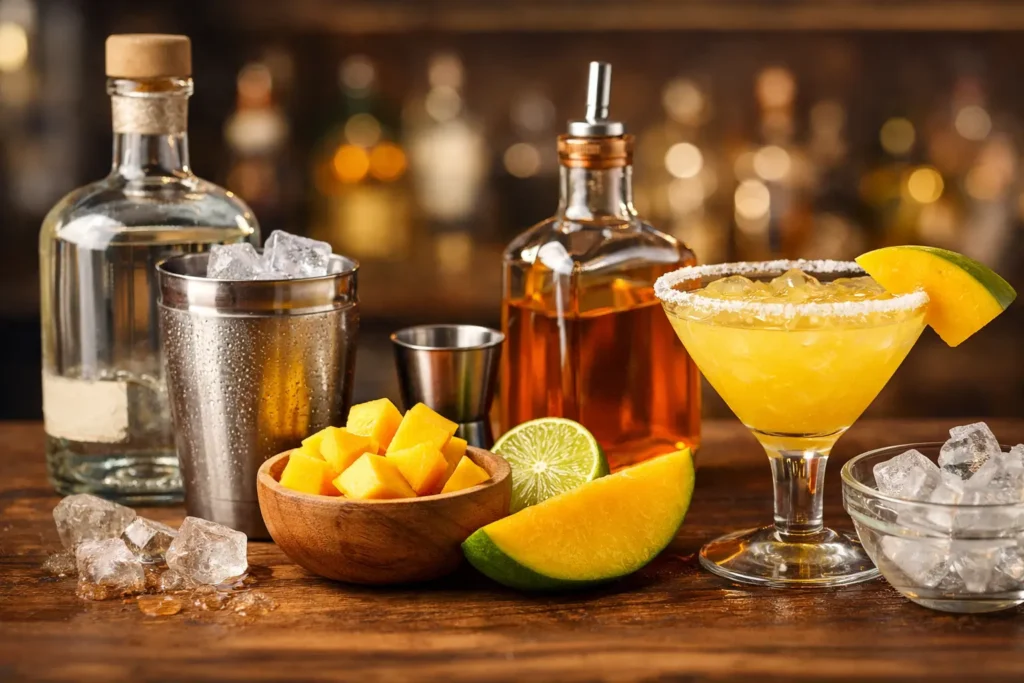
Ataulfo mangoes, also called Champagne mangoes, gave me the smoothest texture and the cleanest tropical flavor. They are smaller and more golden than the typical supermarket mango, with almost no fiber and an intensely sweet, buttery flesh. Kent mangoes worked well too, especially for blended drinks. Tommy Atkins, which are the most common in supermarkets and easily identified by their red and green skin, often taste fibrous and less aromatic unless perfectly ripe. In a side-by-side test with Ataulfo and Tommy Atkins using identical proportions, the tequila tasted noticeably brighter in the Ataulfo version simply because the fruit was softer and less stringy.
That surprised me more than any tequila experiment I ran.
If you can choose, Ataulfo mangoes every time. And here is a tip worth knowing: if you find excellent Ataulfo mangoes at peak ripeness, peel, dice, and freeze them yourself. Homemade frozen Ataulfo produces a better frozen margarita than store-bought frozen Tommy Atkins chunks, because you froze the right fruit at the right moment rather than whatever variety the processor chose.
How to Tell If Your Mango Is Actually Ready to Use
Color is not reliable, and learning this changed my results immediately.
A mango can look deep orange-red and still taste starchy and raw. I learned that the hard way after making a batch that somehow tasted both sweet and flat at the same time, the fruit looked ripe but was not.
The best indicator is softness. A ripe mango should yield slightly when pressed, similar to a ripe avocado. It should not feel mushy or wet, just gently giving.
Smell matters equally. Press your thumb near the stem end and smell. If the aroma is fragrant, tropical, and distinctly mango, the flavor will be there. If it smells like nothing, the cocktail will taste like nothing regardless of what else you add.
Underripe mango adds thickness without enough sweetness or aroma to justify it. The drink becomes heavy and flat simultaneously, the worst possible combination.
Fresh Mango vs Frozen vs Puree: Three Genuinely Different Cocktails
These three options do not belong in the same category and treating them interchangeably is where most recipes go wrong.
Fresh mango creates the brightest cocktail. The aroma jumps out of the glass and the drink keeps genuine separation between citrus, tequila, and fruit. The downside is inconsistency, ripeness varies enormously and so does the flavor.
Frozen mango makes the best blended version because the fruit itself provides cold temperature and body simultaneously. You need far less ice, which preserves flavor concentration. For frozen versions, use frozen mango chunks as the primary frozen element and add only a small handful of additional ice.
Puree produces the smoothest texture but often the sweetest cocktail. Commercial purees frequently contain added sugar that builds as the ice melts. If using puree, taste it before mixing and reduce any additional sweetener accordingly. Puree works best for batching because it gives consistent results across multiple glasses.
After testing all three repeatedly, the pattern I kept arriving at: fresh for shaken on-the-rocks versions, frozen for blended versions, puree for large party batches where consistency matters more than brightness.
Why Mango Thickness Changes How You Build the Whole Drink
Mango absorbs dilution differently from citrus-heavy cocktails and this changes almost every preparation decision.
A standard margarita can handle a shorter shake without falling apart. Mango cannot. When I first made this recipe, I shook it the same way I shake a classic margarita, around six seconds. The texture stayed oddly dense, the center of the drink never fully chilled, and the mango and tequila never properly integrated.
Extending the shake to fifteen seconds fixed it completely. Dave Arnold’s work on dilution as an active cocktail ingredient rather than a byproduct makes immediate sense with this drink. Thick fruit needs more integration with the ice or the drink feels heavy rather than refreshing.
When Your Puree Is Too Thick to Shake Properly
This problem comes up constantly with commercial mango puree and nobody explains the solution.
Some purees are thick enough that shaking them with ice creates an uneven cocktail, the liquid components integrate while the puree stays in clumps that only fully mix after a few minutes of drinking. The instinct is to add more ice to thin it out. That is the wrong fix because it dilutes the flavor along with the texture.
The correct solution is adding a small splash of cold water or club soda, no more than half an ounce, directly to the shaker before the ice goes in. This loosens the puree without adding dilution, the ice then chills and integrates everything evenly, and the final drink has the right texture throughout rather than becoming watery at the bottom as the ice melts. This same soda water technique also works in the finished glass if the drink feels slightly too thick to drink comfortably.
The Ingredient Decisions That Matter for This Specific Fruit
Tequila: What Survives Mango’s Dominant Sweetness
Blanco tequila won easily across all my testing. A grassy or citrus-forward blanco cuts through mango best because the brightness survives the fruit’s density. Reposado can work but vanilla-heavy oak notes sometimes make the cocktail feel too dessert-like; one test with an aggressively vanilla-forward reposado tasted almost like a tropical cake rather than a margarita.
I keep coming back to clean peppery blanco because it keeps the drink recognisable as a margarita first.
Lime Juice: More Than You Think You Need
This was the biggest adjustment across all my testing and the insight most readers find counterintuitive.
Frozen mango specifically tastes less acidic than fresh mango, even when equally ripe. Without enough lime, the frozen version becomes dull almost immediately. One reader made this exact complaint about a competitor’s recipe, “lime killed the mango flavour”, which tells you they overcorrected in the other direction. The truth is that frozen versions need more lime than shaken fresh versions, not less.
For shaken versions I use one ounce of lime. For frozen versions I push to one and a quarter ounces. That small difference changes the entire drink.
Orange Liqueur: Dry Works Better Here Than Sweet
I strongly prefer Cointreau over sweeter triple sec options. Mango already contributes softness and sweetness naturally. A sugary orange liqueur blurs the drink completely and the tequila becomes impossible to find.
The drier style keeps the cocktail sharper and lets each ingredient stay distinct rather than merging into one undifferentiated tropical note.
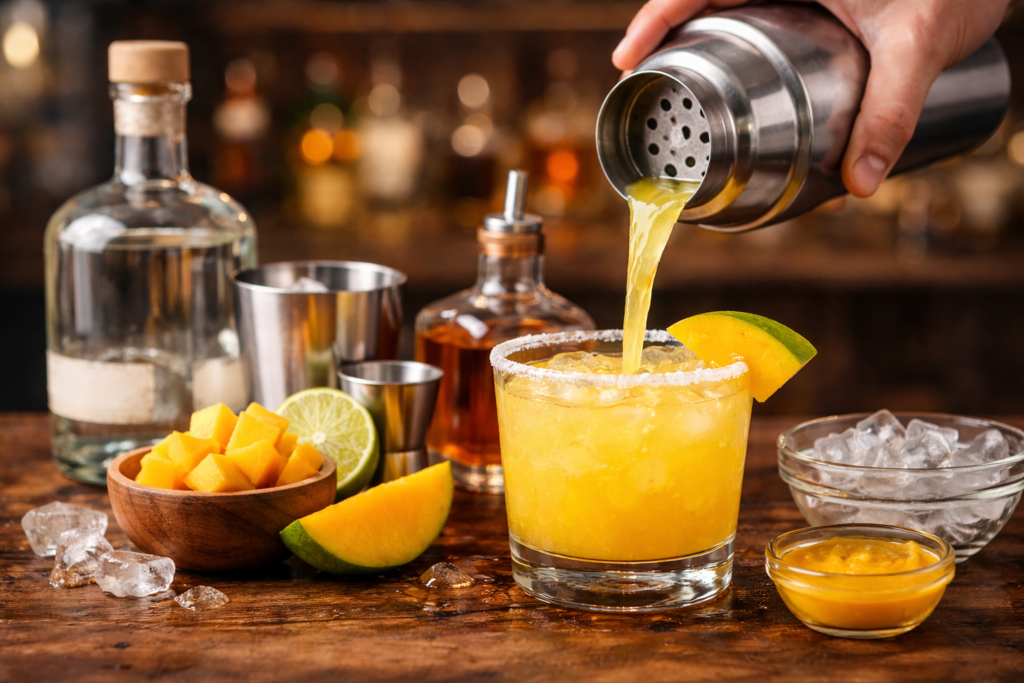
My Go-To Mango Margarita On the Rocks
This is the version I return to most often because it still tastes like a margarita first and a fruit drink second.
Ingredients
- 2 oz blanco tequila A clean peppery blanco because mango already brings enough richness without oak character adding more.
- 1 oz fresh lime juice Fresh matters more here than in many margaritas because mango’s sweetness suppresses acidity perception so strongly.
- 1 oz Cointreau Dryness keeps the cocktail sharp where mango wants to push it soft.
- 1½ oz fresh mango puree or very ripe fresh mango If using commercial puree, taste it first and adjust agave accordingly.
- ¼ oz agave syrup, only if needed after tasting Often unnecessary with ripe fruit.
- Optional: small splash cold water or club soda if puree is very thick Added directly to the shaker before ice.
- Ice, Tajín or salt for rim
Instructions
If using fresh mango, blend the flesh until completely smooth first. If fibrous, strain once through a fine mesh sieve before adding to the shaker, fibrous bits floating through the drink are noticeable and unpleasant.
Add puree, tequila, lime, Cointreau, agave if using, and the cold water splash if needed, to a shaker filled with ice.
Shake hard for 15 seconds. Longer than a standard margarita, intentionally. Mango needs the extra integration time or the texture stays uneven.
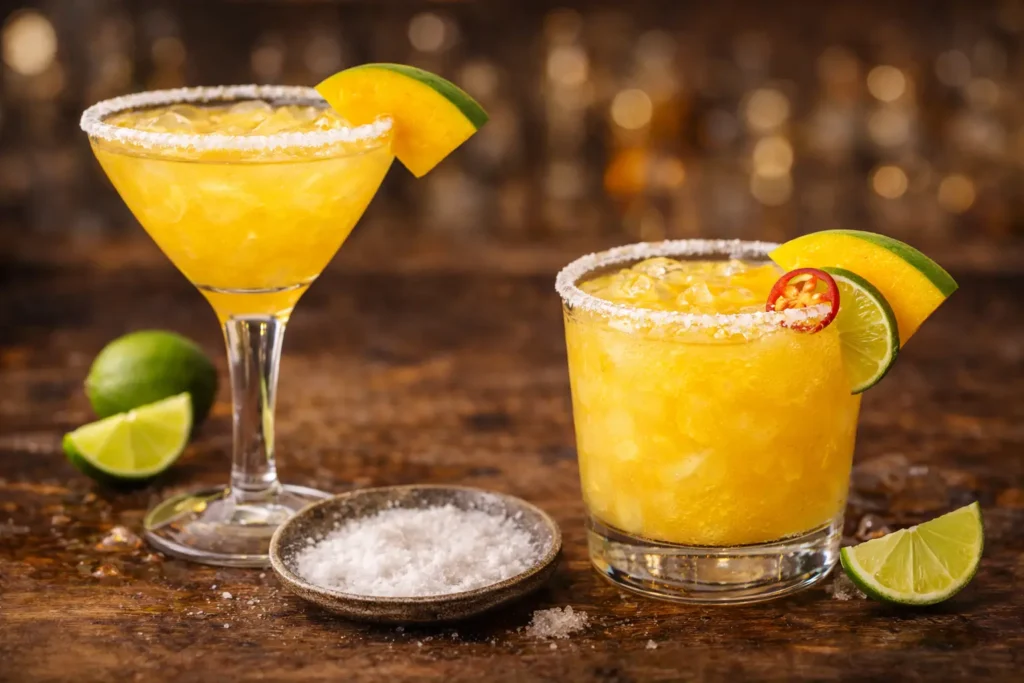
Strain into a Tajín-rimmed rocks glass over fresh ice.
Why the Shake Time Matters More With Thick Fruit
Mango traps warmth surprisingly well compared to juice-based fruits.
Short shaking leaves the center of the cocktail almost creamy while the outside becomes watery from melting ice. The drink feels disconnected, thick in one sip, thin in the next. Once I extended the shake to fifteen seconds, the texture became smooth and consistent throughout and the drink noticeably brighter.
That one change improved the cocktail more than switching tequila brands.
Frozen Mango Margarita: Getting the Texture Right
The biggest frozen margarita mistake is using both frozen fruit and a full blender of ice.
You do not need both. Frozen mango already provides cold temperature and body. Adding the same amount of ice you would use in a strawberry or pineapple frozen margarita creates a watery slush that loses flavor within minutes of being poured.
Ingredients
- 2 oz blanco tequila
- 1¼ oz fresh lime juice, slightly more than the shaken version
- 1 oz Cointreau
- 1½ cups frozen mango chunks, Ataulfo frozen at home if possible
- Small handful of ice only
- Optional: Tajín rim
Instructions
Blend everything until smooth. Stop as soon as the texture turns uniform, overblending aerates the mixture and weakens both flavor and color.
The texture should pour slowly but still feel drinkable through a straw. If it resembles sorbet it has gone too far. If it feels too thick even after blending correctly, add a small splash of club soda and pulse once more.
Taste before serving. Frozen versions frequently need a touch more lime than expected.
Should You Try It With Mezcal?
Yes, but only as a partial substitution.
Pineapple handles smoke better, but mango’s sweetness also softens smoky notes enough to make mezcal interesting here. A full mezcal substitution overwhelmed the mango completely in my testing. The better approach is splitting: one and a half ounces blanco tequila alongside half an ounce of mezcal. That gives enough smokiness to be interesting without burying the fruit.
This ratio works especially well with the jalapeño variation below because smoke, heat, and tropical sweetness create a genuinely complex flavour combination.
Why Mango and Chilli Is Not Just a Trend
Tajín on fresh mango is a Mexican street food tradition with real culinary roots. The pairing exists because mango’s sweetness and chilli’s heat create a specific contrast that is established and flavourfully logical, the heat does not fight the fruit, it sharpens it.
For a spicy version, I muddle two thin jalapeño slices directly in the shaker before adding other ingredients. Leaving jalapeño in too long pulls bitterness from the skin that compounds unpleasantly with mango’s natural sweetness. A brief muddle and an immediate shake keeps the heat green and bright.
A Tajín rim with this variation connects the garnish to the chilli in the drink and makes the whole cocktail feel intentional rather than assembled.
The Colour Problem When Batching Mango for Parties
Fresh mango oxidises faster than most people expect and this is a real practical problem for party preparation.
A bright golden batch can become noticeably dull and brownish after sitting for an hour, especially if air circulates in the container. Lime juice helps slow oxidisation but does not stop it entirely.
For parties, I mix tequila, Cointreau, and mango puree ahead of time and keep the batch sealed and refrigerated. I add fresh lime no more than thirty minutes before serving. Individual glasses are shaken from the batch rather than poured directly, the aeration from shaking refreshes the flavor noticeably and the individual chilling keeps the color brighter per glass than a pitcher sitting over ice.
If you need to batch completely ahead with no last-minute shaking, use commercial puree rather than fresh blended mango. Puree oxidises more slowly and maintains a more consistent color over several hours.
I Kept Making This Drink Too Thick. Here Is How I Fixed It
The mistake I kept making was treating mango like strawberries. They are completely different ingredients that require completely different thinking.
Every time an early version felt slightly off, I added more mango. That always made the drink worse. Mango sweetness and thickness compound quickly once chilled, the first sip might taste balanced while the third feels exhausting and heavy.
My fix was straightforward once I identified the real problem: reduce mango slightly, increase lime modestly, shake longer, and use less ice in frozen versions. Nothing dramatic. Just proportions that respect what mango actually does in a cocktail rather than treating it like a flavored syrup.
Batching for a Party Without the Texture Falling Apart
Mango batches require more attention than most cocktails because the puree or fresh mango settles in a way that juice-based batches do not.
I stir the batch aggressively before pouring each round rather than assuming it stays evenly mixed. For larger gatherings I prefer commercial mango puree over fresh fruit specifically because the consistency stays more stable over time. Fresh mango tastes brighter but separates and oxidises faster. That tradeoff is worth understanding before making a pitcher for twenty people.
For a pitcher serving six to eight people:
- 1½ cups blanco tequila
- 1 cup fresh lime juice
- 1 cup Cointreau
- 2 cups mango puree
- Agave to taste, always add after tasting the puree
Mix tequila, Cointreau, and puree ahead of time and refrigerate. Add lime juice thirty minutes before serving. Shake individual servings rather than pouring from the pitcher, the texture and freshness of each glass improves noticeably.
A Quick Note on Non-Alcoholic Versions
This works as a mocktail more successfully than most fruit margaritas because mango carries enough flavor and visual appeal to stand alone without tequila.
Replace the tequila with chilled sparkling water or a non-alcoholic tequila alternative. Keep the lime and Cointreau or substitute Cointreau with a small amount of orange juice if avoiding alcohol entirely. The drink becomes lighter and fresher rather than feeling like something is missing.
A Mango Margarita Question Worth Answering
People ask whether mango margaritas should taste creamy.
My answer is no, they should feel lush and smooth, but still crisp enough to remind you that you are drinking a margarita. Once the cocktail starts drinking like a smoothie, the balance is gone and you have lost what makes it interesting.
That became my benchmark while testing every version: does this still taste like a margarita? If yes, the balance is right. If it only tastes like mango, something needs adjustment, and the fix is almost always less fruit and more lime, not more tequila.
Faqs
What’s the secret to a smooth mango margarita?
The secret to a smooth mango margarita is using ripe mango and blending it properly. Fresh, fully ripe mango provides natural sweetness and a creamy texture, which reduces the need for added sugar. If fresh mango isn’t available, high-quality frozen mango works well and also helps create a thicker consistency without adding too much ice. For best results, blend the mango first until completely smooth before adding tequila, lime juice, and ice. Straining the puree can remove any remaining fibers, giving your margarita a silky finish. Using freshly squeezed lime juice instead of bottled juice also makes a big difference in flavor and smoothness.
How do I make my margarita taste better?
To make your margarita taste better, focus on balance and fresh ingredients. A classic margarita combines tequila, fresh lime juice, and orange liqueur in a balanced ratio, typically 2 parts tequila, 1 part lime juice, and 1 part orange liqueur. Fresh lime juice adds brightness, while a quality orange liqueur enhances depth and sweetness. Adjust sweetness with a small amount of agave syrup if needed, especially when using tart fruit. Chilling your glass, using good-quality ice, and adding a pinch of salt (either on the rim or directly in the drink) can enhance the overall flavor. The key is balancing sweet, sour, and strong elements without overpowering the tequila.
What tequila is best for mango margaritas?
The best tequila for mango margaritas is typically a 100% blue agave blanco (silver) tequila. Blanco tequila has a clean, crisp flavor that pairs well with the natural sweetness of mango without overpowering it. Brands like Patrón, Don Julio, and Espolòn are known for producing quality 100% agave tequilas. Reposado tequila can also work if you prefer subtle oak and vanilla notes, but blanco is generally preferred for fruity margaritas because it keeps the drink bright and refreshing. Always check the label for “100% agave” to ensure better quality and smoother taste.
How to make mango cocktail at home?
Making a mango cocktail at home is simple and requires only a few ingredients. Start by blending 1 cup of ripe mango (fresh or frozen) until smooth. Add 2 ounces of tequila, 1 ounce of freshly squeezed lime juice, and 1 ounce of orange liqueur. Blend with ice for a frozen version or shake with ice for a classic style and strain into a glass. You can rim the glass with salt or chili salt for extra flavor. If you prefer a non-alcoholic mango drink, simply replace the tequila and orange liqueur with sparkling water or soda for a refreshing mango mocktail. Using fresh ingredients ensures the best flavor and texture.
What is the very best margarita mix?
The very best margarita mix is one made with fresh lime juice, natural sweetener, and no artificial flavors. Homemade margarita mix is often considered superior because you control the sweetness and freshness. A simple homemade mix includes fresh lime juice, a small amount of agave syrup, and a splash of orange juice. If you prefer a store-bought option, look for mixes that use real cane sugar and natural citrus juices rather than high-fructose corn syrup. Reading the ingredient list is important; the fewer artificial additives, the better the taste. Fresh ingredients almost always deliver a brighter, more authentic margarita flavor.
References
International Bartenders Association – Official Margarita Specification
The Spruce Eats – Margarita Ratios and Variations
Tequila Regulatory Council (Consejo Regulador del Tequila)

Muhammad Hussain is the creator of MargaritaLab.com, where he tests and analyzes margarita recipes, ingredients, and techniques to help readers make better drinks at home. Over time, he has experimented with different tequila types, lime juice variations, and store-bought mixes to understand what actually makes a balanced margarita.
His approach combines hands-on testing with detailed research, focusing on real-world results rather than theory. Whether comparing fresh vs bottled lime juice or reviewing popular margarita mixes, his goal is to simplify the process and share what truly works.
Pingback: Cointreau vs Orange Liqueur: Discover the Best Choice for Your Margarita
Pingback: Is Triple Sec Strong? What Most People Get Wrong Before Mixing
Pingback: Best Margarita Glasses for Home Bartenders (Tested & Ranked)
Pingback: Jalapeno Margarita Recipe: How to Make the Perfect Spicy Margarita
Pingback: Grand Marnier vs Triple Sec vs Cointreau with Full Comparison
Pingback: Skinny Margarita Recipe: One Swap Cuts About 60 Calories (Here's the Math)
Pingback: How to Make a Margarita at Home: 5 Tricks Real Bartenders Actually Use